Author: Rajesh Chhabra

  • GCC VS Traditional Outsourcing: Which Model Fits Your Business?

    GCC VS Traditional Outsourcing: Which Model Fits Your Business?

    GCC vs. Traditional Outsourcing: Which Model Fits Your Business?

    As companies scale their global operations, one strategic question keeps coming up in boardrooms: build a dedicated Global Capability Center (GCC), or keep relying on traditional outsourcing partners?

    Both models can deliver cost savings, access to talent, and operational efficiency — but they differ in almost every other respect, from control and culture to long-term value creation. At TekIT, we work with businesses across both models, so this post breaks down what each one actually means, how they compare across the factors that matter most, and how to think about which one fits your business.

    What Is a GCC?

    A Global Capability Center (also called a Global In-House Center, or GIC) is a dedicated, wholly-owned offshore or nearshore unit that a company sets up to perform functions that support its core business — IT, finance, HR, analytics, R&D, customer experience, and more. Unlike a vendor relationship, a GCC is an extension of the parent company itself: same brand, same culture, same long-term goals, just built in a different geography to access talent, cost efficiency, or time-zone coverage.

    Think of global companies running large captive centers in India, Poland, or the Philippines that function as innovation hubs rather than back-office cost centers — many of today’s GCCs contribute directly to product development and strategic decision-making.

    What Is Traditional Outsourcing?

    Traditional outsourcing means contracting a third-party vendor to handle specific business functions or projects. The vendor owns the delivery process, manages its own staff, and is typically measured against service-level agreements (SLAs). Common examples include outsourced customer support, IT helpdesk services, payroll processing, or software development projects handed to an external agency.

    The relationship is transactional by design: you pay for a defined output or service, and the vendor is responsible for figuring out how to deliver it.

    Key Differences at a Glance

    FactorGCCTraditional Outsourcing
    OwnershipFully owned subsidiaryThird-party vendor
    ControlHigh — direct oversight of people, process, and IPLimited — governed by contract and SLAs
    TalentHired and trained by you; long-term retention focusVendor’s employees; less visibility into who works on your account
    Cost structureHigher upfront investment, better long-term unit economicsLower upfront cost, ongoing vendor margins
    Speed to launchSlower — requires setup, hiring, infrastructureFaster — vendor is often operational within weeks
    Cultural alignmentStrong — shares parent company’s values and processesVariable — depends on vendor’s practices
    IP & data securityEasier to protect since operations stay in-houseRequires strict contractual safeguards
    ScalabilityDeliberate, planned scalingFlexible, can scale up/down quickly with vendor capacity
    Strategic depthCan evolve into an innovation or R&D hubTypically limited to defined scope of work

    When Each Model Makes Sense

    Choose a GCC when

    • You need long-term, strategic capability rather than short-term task execution.
    • IP protection and data security are critical — think BFSI, healthcare, or technology.
    • You want deep cultural alignment between offshore teams and headquarters.
    • You’re planning for scale, turning a support function into a center of excellence.
    • You have the capital and patience to invest before seeing returns.

    Choose Outsourcing when

    • You need speed — a vendor can be operational in weeks, not months.
    • The function is non-core or short-term, like a seasonal spike or one-off project.
    • You want to avoid capital investment in infrastructure and local entity setup.
    • You’re testing a new market before committing to a long-term presence.
    • Flexibility matters more than control for this function.

    The Hybrid Approach

    Many organizations don’t choose one model exclusively — they blend both. A common pattern is to outsource non-core, transactional work (like IT support or basic transaction processing) while building a GCC for strategic, high-value functions (like product engineering, data science, or R&D).

    Why it works

    A hybrid model lets a business capture the flexibility of outsourcing without giving up control over the capabilities that differentiate it competitively.

    How to Decide

    Ask these questions before committing to a model:

    1. Is this function core to our competitive advantage, or purely operational support?

    2. Do we need this capability for the next few quarters, or the next decade?

    3. How sensitive is the data or IP involved?

    4. Can we absorb the upfront cost and time required to build a captive center?

    5. How much control do we need over hiring, culture, and process?

    If the answers point toward long-term strategic value, tight control, and IP sensitivity — a GCC is likely the stronger investment. If speed, flexibility, and lower upfront cost matter more — traditional outsourcing remains a proven, lower-risk path.

    Final Thoughts

    There’s no universally “better” model — only the model that’s better for your specific business stage, goals, and risk appetite. GCCs offer control, cultural alignment, and long-term value but demand real investment and patience. Traditional outsourcing offers speed and flexibility but comes with less control and shallower strategic depth.

    The smartest global operating strategies often don’t pick one over the other — they use each model where it fits best.

    How TekIT Can Be Your Strategic Partner

    Choosing between a GCC and outsourcing isn’t a one-time decision — it’s an evolving part of your global operating strategy. TekIT partners with businesses at every stage of that journey, not just to execute a model, but to help you get the strategy right from the start.

    Strategic Advisory

    • Feasibility studies, cost modeling, and location assessment to determine whether a GCC, outsourcing, or hybrid model fits your goals.
    • Roadmaps that account for where your business is headed, not just where it is today.

    End-to-End Execution

    • Setup and scaling support for GCCs — entity formation, infrastructure, compliance, and talent acquisition.
    • Managed outsourcing services for functions where speed and flexibility matter most.
    Why partner with TekIT

    We don’t push a single model — we help you build the right mix, and stay with you as your needs evolve, from first hire to full-scale center of excellence. Get in touch with our team to talk through what fits your business.

    TekIT · Global Operating Models · Business Strategy
  • How to Set Up a GCC in India in 2026: A Step-by-Step Guide for Mid-Market Companies

    How to Set Up a GCC in India in 2026: A Step-by-Step Guide for Mid-Market Companies

    How to Set Up a GCC in India in 2026: A Step-by-Step Guide for Mid-Market Companies | TekIT Software Solutions
    📌 Editorial Note: This guide is published by TekIT Software Solutions Pvt Ltd, an IT staffing and software development company based in Indore, India. Our perspective is informed by first-hand experience operating in a Tier-2 city ecosystem.
    ✦ GCC Strategy Guide · June 9, 2026

    How to Set Up a GCC in India in 2026: A Step-by-Step Guide for Mid-Market Companies

    By TekIT Software Solutions Editorial Team 📖 12 min read 🗓 Published June 9, 2026

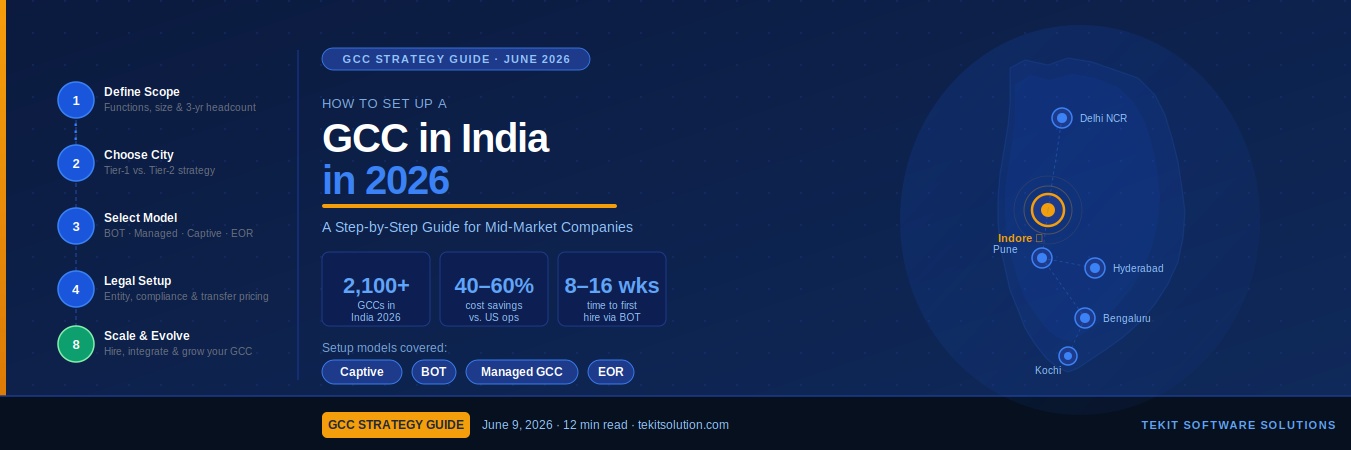
    GCCs in India are no longer a large-enterprise privilege. With the GCC market projected to cross USD 952 billion by 2031, mid-market companies — those with 50 to 500 employees — are increasingly setting up their own capability centres and reaping the same cost, talent, and innovation advantages that Fortune 500 companies have enjoyed for decades. This guide walks you through exactly how to do it in 2026, step by step.

    2,100+
    GCCs operating in India in 2026
    $649B
    Global GCC market size in 2026
    40–60%
    Cost savings vs. equivalent US operations
    8–16 wks
    Typical time to first hire via BOT model

    What Is a GCC — and Why It’s No Longer Just for Large Enterprises

    A Global Capability Center (GCC) is a captive offshore unit set up by a company in another country to deliver technology, engineering, analytics, or business operations at scale. Think of it as your own dedicated engineering team on the ground in India — not a vendor you hire, but an extension of your organisation that you fully own and control.

    For years, GCCs were synonymous with IBM, Microsoft, and Goldman Sachs. But that narrative has changed decisively. Today, 480 GCCs — 27% of India’s total — are operated by mid-sized enterprises. The playbooks have matured, the setup models have become more accessible, and Tier-2 cities have opened up entirely new cost brackets. If you’re a CTO or Head of Engineering at a company with 50 to 500 employees, 2026 is the most accessible year in history to set up your own GCC in India.

    GCC vs. Outsourcing vs. ODC: A GCC is fully owned and operated by your company. You control hiring, culture, tooling, and IP. Outsourcing hands off delivery to a third party. An Offshore Development Centre (ODC) is a lighter-touch version — usually a managed workspace without entity setup — ideal for pilot teams under 20 engineers before committing to a full GCC.

    Why India — and Why 2026 Is the Right Time

    India’s GCC dominance is structural, not cyclical. The country hosts over 2,100 GCCs — accounting for approximately 55% of the global GCC market share — and employs more than 2 million professionals across technology, analytics, engineering, and digital transformation. Three factors make 2026 particularly compelling for mid-market entry:

    1. Talent that builds products, not just executes tasks

    Companies are no longer coming to India for support functions. In 2026, India-based GCCs are running core product engineering, AI research, and global P&L ownership. The talent depth in React, .NET, Python, DevOps, and AI/ML is unmatched globally at India’s price point.

    2. Simplified compliance via the Union Budget 2026

    The Union Budget 2026 introduced a uniform 15.5% safe harbour margin for transfer pricing, raising the threshold from ₹300 crore to ₹2,000 crore. This now covers over 1,000 existing GCCs and significantly simplifies the most feared aspect of GCC setup: intercompany pricing compliance.

    3. Tier-2 city infrastructure has matured

    Cities like Indore, Coimbatore, Kochi, and Jaipur now offer Grade A IT parks, reliable connectivity, and strong engineering college pipelines — with 30–45% lower fully-loaded costs than Bengaluru, and meaningfully lower attrition due to reduced employer competition.

    💡 Mid-market insight: A recent viability report found that first-time mid-market GCC entrants targeting 50–200 person teams are increasingly skipping Tier-1 cities entirely. The cost case, state incentives, lower attrition, and parallel-track setup delivers a 9–12 month time-to-operational that is competitive with Tier-1 — at 35–45% lower fully-loaded cost.

    Choosing Your GCC Setup Model

    Before you set a timeline or budget, you need to choose the right model. This is the foundational decision that shapes everything else — your timeline, IP control, risk exposure, and operational complexity.

    Model What it is Time to first hire Best for
    Captive (WOS) Wholly-owned Indian subsidiary. Full control, full IP protection, full compliance responsibility. 16–24 weeks Enterprise Long-term, 50+ engineers
    Build-Operate-Transfer (BOT) A local partner builds and runs your GCC for 12–24 months, then transfers full ownership to you. 8–16 weeks Mid-market New to India, want speed + path to ownership
    Managed GCC You own the GCC but outsource day-to-day HR, payroll, and compliance to a specialist provider. 6–12 weeks Mid-market Ownership benefits without operational burden
    EOR (Employer of Record) A local provider legally employs talent on your behalf. Zero entity setup. You retain full functional control. 2–5 days Pilot Testing India with 5–15 engineers before committing
    TekIT’s recommendation for mid-market companies: Start with the BOT or Managed GCC model. It gives you speed to market (8–16 weeks vs. 24+ weeks for a captive), a clear path to ownership, and dramatically lower early-stage risk. Many global companies begin with EOR or BOT and transition to a wholly-owned subsidiary once operations stabilise — typically after 12–18 months.

    Step-by-Step: How to Set Up Your GCC in India in 2026

    Here is a practical, sequenced playbook based on how successful mid-market GCCs are being set up in India in 2026.

    1

    Define Scope, Size, and Functions

    Before anything else, define what your GCC will do. Product engineering? QA automation? AI/ML? Finance ops? The function determines the talent profile, which determines the city. A 30-engineer React/DevOps team belongs in a different city than a 100-engineer BFSI compliance analytics unit. Set a 3-year headcount target — this drives every downstream decision.

    ✓ TekIT tip: Start with your most bottlenecked function — the one causing the most hiring pain in your home country.
    2

    Choose Your City and Location Strategy

    Tier-1 cities (Bengaluru, Hyderabad, Pune) offer the deepest talent pools but come with higher costs and 20–25% annual attrition. Tier-2 cities (Indore, Coimbatore, Kochi, Jaipur) offer 30–45% lower fully-loaded costs and attrition rates that are meaningfully lower due to limited employer competition and better work-life balance. For teams under 200 engineers, the Tier-2 case is increasingly hard to ignore.

    ✓ TekIT tip: For full-stack, .NET, React, and DevOps teams — Indore is a strong, undervalued choice with a fast-maturing IT ecosystem.
    3

    Select Your Setup Model and Local Partner

    Based on your timeline, budget, and risk appetite (see the model table above), select BOT, Managed GCC, EOR, or Captive. If choosing BOT or Managed GCC, vet partners carefully — ask for reference clients, a day-one onboarding checklist, and clarity on the transfer mechanics. Misalignment on talent quality and culture from Day 1 is the most common failure point in BOT engagements.

    ✓ TekIT tip: A good partner should be able to name existing GCC clients in your industry and describe their attrition rate in the first meeting.
    4

    Legal Entity Setup and Compliance Registration

    If going the Captive route, register a Private Limited Company (most common) or LLP. Required filings include company incorporation via MCA, PAN, TAN, GST, ROC, and EPF registrations. Engage a Big 4 or mid-tier Indian accounting firm to set up your transfer pricing policy from Day 1 — most GCCs use a cost-plus model (cost of operations plus 10–15% markup). India’s Digital Personal Data Protection Act 2023 (DPDPA) governs cross-border data transfers and must be addressed in your contracts.

    ✓ TekIT tip: Budget 8–12 weeks and USD 50,000–150,000 for legal entity setup. Retroactive transfer pricing corrections are expensive — get this right upfront.
    5

    Office Space and Infrastructure

    Grade A IT park leases typically require 3–5 year commitments with 6–12 months of security deposit. In Tier-1 cities, Bengaluru Grade A space averages ₹75–120 per sq ft/month. Tier-2 cities run 40–60% cheaper. Budget for cybersecurity frameworks, cloud infrastructure (AWS/Azure/GCP), collaboration tools, and hardware procurement. Many mid-market GCCs start in managed coworking IT parks to avoid long-term lease commitments during the first 12 months.

    ✓ TekIT tip: Negotiate for a 12-month break clause in your first lease. Your headcount projections will be wrong — build in flexibility.
    6

    Talent Acquisition and Onboarding Strategy

    Hire a strong India Head before recruiting engineers. This person shapes culture, makes hiring calls, and manages day-to-day operations — the most important hire in your GCC journey. For engineers, partner with a local IT staffing firm with pre-vetted talent to compress time-to-hire. Top-tier GCCs target 10–15% annual attrition; mid-level setups average 15–25%. Retention drivers include career growth paths, competitive pay versus local market (not global), and an actively communicated connection to global product outcomes.

    ✓ TekIT tip: Publish your salary bands internally from Day 1. Opacity on compensation is the fastest path to attrition in Indian engineering teams.
    7

    Knowledge Transfer and Integration with Global Teams

    The gap between “we have engineers hired” and “those engineers are shipping meaningful work” is where GCCs most often stall. Build a structured 90-day integration programme: Week 1–2 is tooling and codebase orientation; Week 3–4 is paired working with home-country counterparts; Month 2 is shadowed ownership; Month 3 is independent sprint contribution. Avoid the common failure of treating the India team as a feature factory — connect every engineer to a product outcome they can see in production.

    ✓ TekIT tip: Assign a named “buddy” in your home-country team to every India hire for the first 90 days. Retention improves measurably.
    8

    Scale, Optimise, and Evolve

    Most mid-market GCCs hit their operational stride at Month 12–18. At this point, review your setup model — if you started with EOR or BOT, this is typically the right window to transition to a wholly-owned subsidiary. Expand functions systematically: start with product engineering, add QA automation in Year 2, consider AI/ML or data engineering in Year 3. GCCs that try to do everything at launch consistently underperform those that sequence deliberately.

    ✓ TekIT tip: Set a GCC maturity review at Month 12 — cost per engineer, attrition rate, sprint velocity, and NPS from home-country stakeholders are the four metrics that matter most.

    Choosing the Right City: Tier-1 vs. Tier-2 in 2026

    Location strategy is not a Year-2 decision. The city you choose determines your talent pool, cost structure, attrition risk, and competitive landscape from Day 1. Here is a practical comparison of the key options for mid-market GCCs in 2026.

    Tier-1 · Deep Tech Hub
    Bengaluru
    Largest AI, cloud, and deep-tech talent pool. Preferred for AI/ML and fintech. High cost, 20–25% attrition, intense salary competition. Best for 100+ engineer teams with deep-tech mandates.
    Tier-1 · Life Sciences & Analytics
    Hyderabad
    Strong in life sciences, data engineering, and analytics. 430+ GCCs operating. 20–30% cheaper than Bengaluru. Government offers single-window clearance for GCC setup.
    Tier-1 · Engineering & Fintech
    Pune
    Strong automotive tech, engineering, and fintech talent. More affordable than Bengaluru. Proximity to Mumbai gives access to financial sector talent. Popular for mid-sized GCCs under 300 engineers.
    Tier-2 · Engineering-Centric
    Coimbatore
    Engineering-centric ecosystem attracting global centres in manufacturing tech, IoT, and automation. Hybrid talent combining engineering fundamentals with digital platform skills. Significantly lower real estate costs.
    Tier-2 · Technology & Healthcare
    Kochi
    Strong in healthcare IT, insurance tech, and e-commerce. Kerala’s high literacy rate and English proficiency give Kochi an edge for client-facing and analytics roles. Supportive state government GCC policy.

    GCC Setup Costs: What to Budget in 2026

    First-year GCC setup costs in India range from USD 1 million to USD 5 million depending on team size, city, and setup model. Here is a realistic cost breakdown for a mid-market GCC of 30–50 engineers in a Tier-2 city like Indore.

    Cost ItemTier-1 City (Bengaluru)Tier-2 City (Indore)
    Legal entity setup & complianceUSD 80,000 – 150,000USD 50,000 – 100,000
    Office space & fit-out (Year 1)USD 400,000 – 800,000USD 180,000 – 380,000
    Engineer salaries (30 FTE, Year 1)USD 900,000 – 1,500,000USD 550,000 – 950,000
    Technology infrastructureUSD 100,000 – 300,000USD 80,000 – 200,000
    Recruitment costsUSD 150,000 – 400,000USD 90,000 – 220,000
    Total Year 1 Estimate (30 FTE)USD 1.6M – 3.1MUSD 950K – 1.85M
    Cost per engineer annually: For most mid-market GCCs in 2026, the fully-loaded annual cost per engineer (salary + overhead + infrastructure) ranges from USD 25,000 to USD 80,000 in India — compared to USD 180,000–280,000 for an equivalent engineer in the US or UK. The savings compound year over year as the team scales.

    5 Common Mistakes Mid-Market Companies Make When Setting Up a GCC

    Defaulting to Bengaluru without evaluating Tier-2 alternatives Bengaluru wins for very large, deep-tech GCCs. For a 30–100 engineer mid-market team, the cost premium and attrition risk often outweigh the talent depth advantage. Run a proper location analysis before committing.
    Treating the GCC like an outsourcing vendor GCC engineers are your employees. Managing them at arm’s length, assigning only execution tasks, or failing to connect them to product outcomes is the fastest route to high attrition and low-quality output. Integrate them as deeply as your home-country team.
    Skipping the BOT model to save the transfer fee Many mid-market companies try to go straight to a captive entity to avoid the BOT partner fee — and spend 6–12 months navigating legal, HR, and real estate complexity with no India experience. The BOT fee typically pays for itself within 3 months of avoided delays.
    Delaying transfer pricing setup India’s tax authorities actively scrutinise GCC intercompany arrangements. Retroactive transfer pricing corrections are expensive and trigger audits. Set up your cost-plus intercompany pricing policy before the first invoice is raised — not after.
    Hiring engineers before hiring the India Head The India Head is the most important hire in your GCC journey. Recruiting 20 engineers without a senior local leader to onboard, manage, and retain them is a predictable failure. Fill the Head role first — even if it delays your engineer hiring by 4–6 weeks.

    How TekIT Software Solutions Helps You Get There

    TekIT Software Solutions is headquartered in Indore — one of India’s fastest-rising Tier-2 GCC cities — with a US presence and a pre-vetted talent pool spanning React, .NET, Angular, Flutter, DevOps, Java, and more. We serve companies looking to:

    • Start with staff augmentation before committing to a full GCC — testing the India talent market with pre-screened engineers via C2C or C2H engagement models
    • Bridge the gap from a remote team to a full offshore development centre with dedicated engineers, structured onboarding, and transparent pricing
    • Explore Indore as a Tier-2 GCC location with lower costs, stronger talent loyalty, and direct access to our existing engineering ecosystem

    Whether you’re a CTO exploring your first India hire or an Engineering Director ready to build a 50-person GCC, we’ve been operating in this market since 2018 and can help you move faster with fewer surprises.

    Not ready for a full GCC yet? Many companies start by augmenting 2–5 engineers through TekIT on a C2C or dedicated team basis. This gives you 6–12 months of real experience with India-based engineering talent — the most valuable input you can have before committing to a GCC entity. Explore our staffing models →

    Frequently asked questions

    What is the difference between a GCC and an offshore development centre (ODC)?

    A GCC is a fully-owned captive entity — your company registers a legal entity in India, hires directly, and owns all IP and operations. An ODC is a lighter model where a partner provides managed workspace, HR, and payroll, while you direct the work. ODCs are ideal for pilot teams of 5–50 before committing to the full entity route. Many companies begin with an ODC and transition to a GCC after 12–18 months.

    How long does it take to set up a GCC in India?

    It depends on the model. An EOR arrangement can have your first hires onboarded in 2–5 days. A BOT or Managed GCC typically delivers first hires in 8–16 weeks. A fully captive entity (WOS) requires 16–24 weeks minimum for legal setup, and often 12–18 months before reaching full operational capability when internal delays and regulatory complexity are factored in.

    How much does it cost to set up a GCC in India for a mid-market company?

    For a team of 30–50 engineers in a Tier-2 city like Indore, expect first-year all-in costs of USD 950,000 to USD 1.85 million. This covers legal entity setup, office space, first-year salaries, technology infrastructure, and recruitment. Tier-1 cities cost 40–60% more for the same team size. Annual cost per engineer in India ranges from USD 25,000 to USD 80,000 fully loaded — vs. USD 180,000–280,000 in the US.

    Is Indore a good city for a GCC in 2026?

    Yes — and increasingly so. Indore is one of India’s fastest-rising Tier-2 GCC destinations in 2026. It offers a strong IIT/NIT/engineering college pipeline, high talent loyalty with lower attrition than metro cities, 35–45% lower fully-loaded costs than Bengaluru, Madhya Pradesh state government incentives (capital subsidies, stamp-duty waivers, power-tariff rebates), and a maturing IT park ecosystem. For mid-market companies targeting 30–150 engineers, Indore delivers a compelling cost-quality combination.

    What legal structure should I use for a GCC in India?

    For most mid-market companies, a Private Limited Company (WOS — Wholly Owned Subsidiary) is the standard choice. It provides the strongest IP protection, allows equity issuance for ESOPs, and is well-understood by Indian regulators. An LLP is simpler to set up but has restrictions on equity compensation — a significant drawback for engineering-focused GCCs. If speed is the priority, start with an EOR provider and transition to a WOS after 12 months.

    How do I manage attrition in an India-based GCC?

    Top-tier GCCs maintain 10–15% annual attrition; mid-level setups average 15–25%. The proven retention levers are: clear career progression paths, transparent and competitive local-market compensation, strong connection to global product outcomes (engineers who can see their code in production stay longer), active manager relationships, and location choice — Tier-2 cities have structurally lower attrition than metros due to limited employer competition and better work-life balance.

    Ready to Build Your GCC in India?

    TekIT Software Solutions has been operating in Indore’s IT ecosystem since 2018. Whether you want to start with 2 augmented engineers or plan a 50-person dedicated GCC, we can help you move faster with fewer surprises.

    Book a Free GCC Consultation Explore Staffing Models
    Published by TekIT Software Solutions Pvt Ltd · Indore, India & USA · Blog · About Us
  • Top 5 IT Staff Augmentation Companies in 2026

    Top 5 IT Staff Augmentation Companies in 2026

    Top 5 IT Staff Augmentation Companies in 2026 | TekIT Software Solutions
    📌 Editorial Disclosure: This article is published by TekIT Software Solutions Pvt Ltd. While we are listed as the #1 provider in this guide, all other companies are included based on independent research from Clutch, GoodFirms, and DesignRush.
    ✦ Expert Resource Guide · May 29, 2026

    Top 5 IT Staff Augmentation
    Companies in 2026

    By TekIT Software Solutions Editorial Team 📖 10 min read 🗓 Updated May 29, 2026

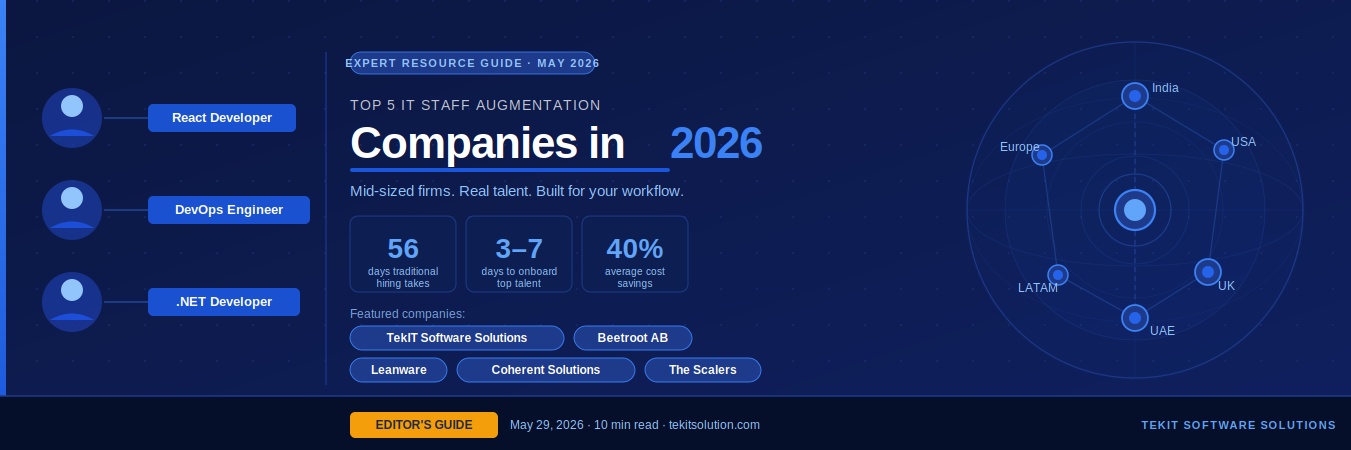
    Not every business needs a 50,000-engineer bench. For SMBs, startups, and growth-stage companies, the best IT staff augmentation partners are responsive, and built around your workflow — not the other way around. The global IT services market exceeds USD 1.65 trillion in 2026, yet the most effective partnerships often come from firms that are agile enough to treat your project like it actually matters. Here are the five augmentation companies worth your attention right now.

    56
    Avg. days to fill a role via traditional hiring
    3–7
    Days to onboard via top augmentation firms
    40%
    Typical cost savings vs. equivalent in-house hire

    The 5 Best IT Staff Augmentation Companies in 2026

    Ranked by talent quality, onboarding speed, engagement flexibility, and verified client satisfaction.

    02
    Best for Sustainability-Driven Teams
    Beetroot AB

    Beetroot AB is a purpose-driven tech ecosystem with engineers across multiple European countries. What sets them apart is a rare combination of transparent pricing and mission-aligned hiring — they filter projects against social-impact criteria before placement, meaning you end up with developers who are genuinely invested in what they’re building.


    Clients on Clutch report a 60% cost reduction and a 100% positive feedback rate, with reviewers consistently praising seamless team integration, proactive communication, and on-budget delivery. A strong fit for HealthTech, GreenTech, and EdTech teams seeking long-tenured engineers on transparent, month-to-month commercial terms.

    600+ engineers across 4 European countries
    100% positive feedback rate on Clutch
    Transparent daily-rate pricing — no hidden sales calls
    Low mid-engagement engineer rotation
    Strong in HealthTech, GreenTech & EdTech
    Mission-aligned project filtering process
    Best for: Mission-driven startups & HealthTech / EdTech teams
    ReactVueAngular Node.jsPythonFlutterDevOps
    03
    Best for US Timezone & Cultural Fit
    Leanware

    Leanware specialises in connecting US businesses with carefully curated developers and engineers from Latin America. Their vetting process is distinctly boutique — emphasising cultural fit and communication style alongside technical ability, so augmented staff integrate smoothly with internal teams from day one rather than requiring months of calibration.


    Unlike firms that prioritise speed and volume, Leanware focuses on the top 3% of Latin American candidates. Engineers typically lead standups within the first sprint. For founders seeking senior-only augmentation without enterprise bureaucracy, Leanware is a strong contender — with verified Clutch reviews praising fast delivery, responsiveness, and a “straightforward, friendly, and collaborative” working style.

    Top 3% of Latin American candidate pool
    Full US timezone overlap — no async delays
    Boutique cultural & communication fit vetting
    Engineers productive from sprint one
    AI-powered full-stack development capability
    Strong Clutch & DesignRush verified reviews
    Best for: US startups & growth-stage companies needing real-time collaboration
    ReactNode.jsAWS Lambda AI/MLMobile (iOS/Android)
    04
    Best for Regulated & Enterprise Stacks
    Coherent Solutions

    Coherent Solutions brings institutional depth without the enterprise pricing. Their engineers have a proven track record in regulated industries — financial services, healthcare, and insurance — where compliance context matters as much as coding ability.


    Their core strength lies in Microsoft and Java stacks for web, mobile, and integration solutions. For companies undergoing digital modernisation of legacy systems — or needing engineers who understand compliance without needing hand-holding — Coherent Solutions hits the sweet spot between boutique responsiveness and genuine technical depth.

    30+ year track record in software engineering
    Deep expertise in regulated industries
    10 global delivery offices for timezone flexibility
    Strong Java, .NET & data platform specialisation
    2,200+ engineers — scale without enterprise bloat
    HQ in USA with nearshore & offshore delivery
    Best for: Fintech, healthcare & insurance companies on Microsoft / Java stacks
    Java.NETMicrosoft Azure Data EngineeringMobile
    05
    Best for Dedicated Offshore Dev Centres
    The Scalers

    The Scalers is the only firm on this list that offers a true dedicated team extension model — building offshore development centres with an all-inclusive monthly fee that covers hiring, onboarding, HR, admin, and infrastructure. No hidden costs, no attrition surprises.


    Their model is purpose-built for companies that want a long-term offshore engineering presence without the complexity of setting up their own entity. They recruit against your specific requirements rather than placing engineers from a bench, which means the team is built for your stack, your culture, and your delivery cadence — not a generic template.

    Only firm offering all-inclusive monthly team extension
    Recruits specifically against your requirements
    Full HR, admin & infrastructure included
    Bangalore-based talent — strong India engineering pool
    Built for long-term partnerships, not short-term bench fills
    Transparent cost structure — no billing surprises
    Best for: Companies building a dedicated long-term offshore engineering presence
    Full-stackDevOpsQA CloudAI/ML

    How to actually choose the right partner

    Lists can only take you so far. Ask these four questions before signing anything.

    01
    How do you screen for communication, not just code? Technical skills are table stakes. The developer who writes elegant React but can’t explain blockers clearly will slow your team down regardless of their GitHub history. Ask how vendors evaluate soft skills — and listen carefully to how they answer.
    02
    What happens if the match doesn’t work out? The best augmentation firms offer replacement guarantees — typically within 1–2 weeks. Firms that hedge on this question are telling you something important about their confidence in their own vetting process.
    03
    Who are your current clients in my industry? Domain experience cuts onboarding time in half. An engineer who’s already shipped healthcare software understands HIPAA. Firms that can’t name relevant clients in your vertical are placing generalists, not specialists.
    04
    What does your onboarding process look like on day one? Ask for a specific onboarding checklist. The gap between “we have a great engineer for you” and “that engineer is productive in your codebase” is where augmentation most often falls apart. Vague answers should raise a flag.

    Frequently asked questions

    What is IT staff augmentation, exactly?

    IT staff augmentation is a flexible hiring model where businesses bring in skilled external tech professionals — developers, QA engineers, DevOps specialists — to work alongside their in-house team on a contract basis, without the overhead of permanent hiring. You maintain full project control; you gain extra capacity and specific skills exactly when you need them.

    Why choose a mid-sized augmentation firm over a large one?

    Mid-sized firms offer better responsiveness, lower overhead, and more personalised service. Large firms optimise for volume — you may find your project handled by junior account managers and bench engineers rather than the senior talent you saw in the pitch. Mid-sized firms have more to prove and typically deliver tighter communication, faster replacements, and genuine domain alignment.

    How quickly can I get an engineer onboarded?

    Top-tier firms like TekIT Software Solutions can place pre-vetted engineers within 3–7 business days. Compare this to 56+ days for traditional hiring — augmentation is meaningfully faster when your timeline is real.

    How much does IT staff augmentation cost in 2026?

    Costs vary significantly by region, skill level, and engagement model. India-based providers like TekIT Software Solutions typically deliver 40–60% cost savings compared to equivalent US-based hiring. European nearshore firms like Beetroot AB offer mid-market pricing with strong quality guarantees. Latin America options like Leanware offer US timezone alignment at competitive rates.

    Is staff augmentation better than outsourcing?

    Staff augmentation gives you control — engineers work within your processes, tools, and culture. Outsourcing hands off entire project delivery to a third party. For companies that want to retain ownership over their product roadmap while expanding capacity, augmentation is the cleaner, lower-risk model.

    Ready to extend your team the smart way?

    Staff augmentation in 2026 is no longer a workaround — it’s a mainstream engineering strategy. For a partner that combines cost-efficiency, genuine technical depth, and responsive client service, TekIT Software Solutions Pvt Ltd is where to start.

    Talk to TekIT Software Solutions Today →
    Published by TekIT Software Solutions Pvt Ltd · Indore, India & USA · IT Staffing Services · About Us

    © 2026 TekIT Software Solutions Pvt Ltd. All rights reserved.

    Home  ·  Blog  ·  Contact

  • Why Spend Hours Screening 8–10 Resumes When 2 Right Fits Are All You Need?

    Why Spend Hours Screening 8–10 Resumes When 2 Right Fits Are All You Need?

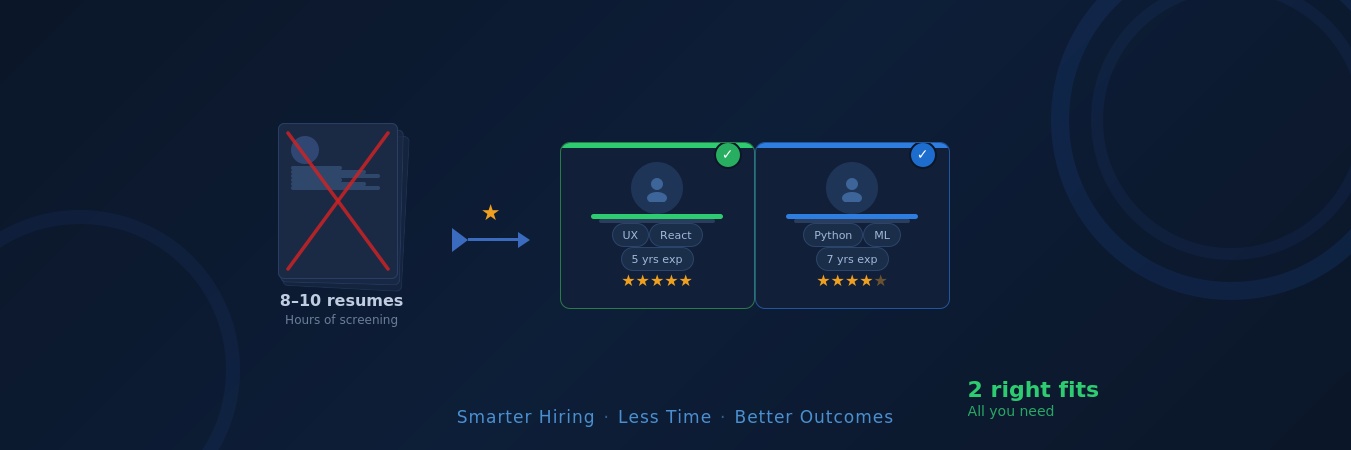
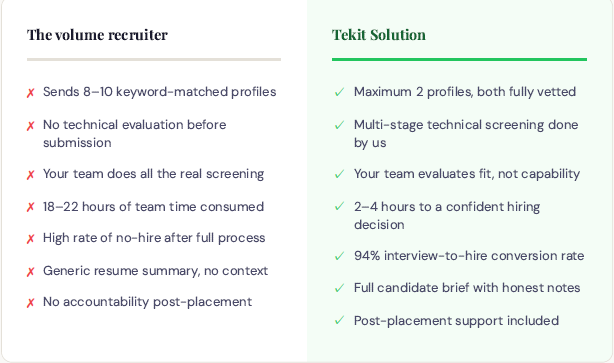
    Trying to hire developers fast shouldn’t mean drowning in 8–10 unvetted resumes. Most recruiters send high volumes of profiles not because they found great candidates, but because filtering takes expertise they don’t have. The result? Your engineering team spends 18–22 hours screening, interviewing, and debriefing, only to end up with the same 2 candidates they needed from day one.

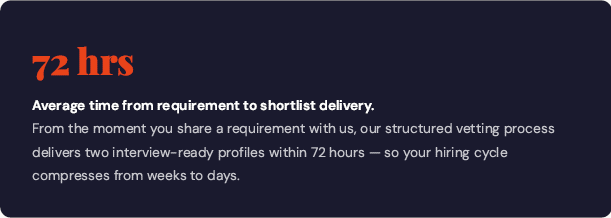
    This post breaks down exactly what that hidden cost looks like, why the volume model fails technical hiring, and how a 2-profile vetting process delivers interview-ready developers in 72 hours — so your team can stop screening and start selecting.

    hire pre-vetted developers

    Think about the last time you tried to hire developers fast. How many resumes landed in your inbox? Eight? Ten? AND of those, how many were actually worth your engineering manager’s time? Two, maybe three — if you were lucky.


    Now think about what happened in between. Someone on your team read every profile, shortlisted a few, scheduled calls, sat through technical rounds, and wrote Feedback — only to conclude what a better-screened shortlist would have told you on day one.


    That gap — between ten resumes received and two worth hiring — is where your company quietly bleeds time and money.

    The Real Reason Recruiters Send 8–10 Profiles

    Companies that need to hire developers fast shouldn’t have to choose between speed and quality — but the volume model forces exactly that tradeoff.

    It is not because they found ten great candidates. It is because sending more profiles is faster than doing the hard work of filtering them. Running a keyword search on a database and forwarding results takes minutes. Technically evaluating which of those candidates can actually solve your problem takes expertise — and most generalist recruiters simply do not have it.


    So the volume model persists. The recruiter appears productive. And the actual screening work — the technical assessment, the culture check, the salary alignment — gets quietly shifted onto your already stretched team.

    This is not recruitment. This is cost-shifting dressed up as service.

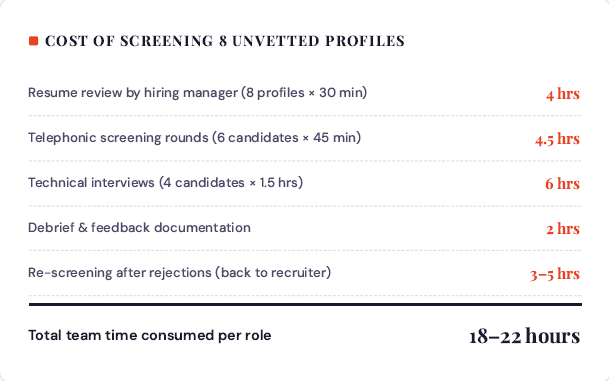
    What Screening 8–10 Resumes Actually Costs Your Business

    The cost is rarely calculated, but it is very real. Here is a conservative breakdown of
    what a single hiring cycle looks like when profiles arrive unvetted:

    smarter screening profiles

    At a senior engineering manager’s billing rate of ₹30–40 LPA, 20 hours of hiring work translates to ₹28,000–₹38,000 in lost productive time — per role, per cycle. For a company hiring four to five engineers a year, that is a silent annual cost of over ₹1.5 lakh in misdirected leadership attention alone.


    And that is before accounting for the cost of a mis-hire, which research consistently places at 30–50% of the employee’s first-year salary.

    The 2-Profile Model: What It Actually Means

    When Tekit Software Solutions says we send two profiles, we do not mean we ran a narrower search. We mean that by the time a candidate’s name reaches your inbox, they have already cleared a multi-stage evaluation designed specifically around your requirements.


    Here is what happens before you see a single profile:

    1. Deep requirement analysis
      We go beyond the job description. We understand your tech stack, team structure, growth stage, and the specific problem this hire needs to solve — so we are not just matching keywords, we are matching outcomes.
    2. Role-specific technical assessment
      Every candidate completes a custom technical assessment tailored to your actual requirements — reviewed and scored by a senior engineer on our team, not by an automated filter.
    3. Structured Live Interview
      We conduct a conversational technical interview to evaluate real problem-solving ability, how candidates communicate under pressure, and how they handle ambiguity — none of which a resume reveals.
    4. Soft-Skill And Culture Alignment
      Technical strength without team fit creates friction. We assess communication style, adaptability, and feedback receptiveness — and cross-reference that against what we know about your team’s working style.
    5. Two Profiles, With Full Context
      You receive a detailed brief on each candidate — technical assessment results, soft-skill observations, salary expectations, notice period, and our honest recommendation. Everything you need. Nothing you don’t.

    Two Vetted Profiles vs. Ten Unscreened Resumes

    Vetted profiles vs unscreened resumes

    What Your Team Should Actually Be Doing In Interviews

    When a candidate arrives at your interview table having already passed a rigorous technical assessment, your team’s job changes completely. You are no longer filtering. You are choosing.

    That shift — from evaluation to selection — is where great hiring decisions are made. Your engineering managers can focus on team dynamics, long-term vision alignment, and the nuanced judgment calls that only insiders can make. The hard, time-consuming work of technical screening is already behind you.

    hire developers within 72 hours

    Who This Model Is Built For

    The 2-profile model is not for every company — and we are upfront about that. It is built for organizations where engineering quality directly impacts business outcomes: product startups scaling their core team, mid-stage companies that cannot absorb the cost of a mis-hire, and enterprise tech teams where senior engineers have multiplier effects on everything they touch.

    If your priority is volume — 50 CVs by tomorrow — we are not the right fit. But if your priority is built for teams that need to hire developers fast — with the right hire, properly assessed, delivered within 72 hours, that is exactly what we are built to do.

    The Bottom Line

    Screening ten resumes to find two good candidates is not a process. It is a workaround for a recruiter who did not do their job. Every hour your team spends filtering profiles is an hour not spent building your product, managing your team, or thinking strategically.

    The question is not whether you can afford to work with a recruiter who pre-vets candidates. The question is whether you can afford not to.

    staffing solutions