
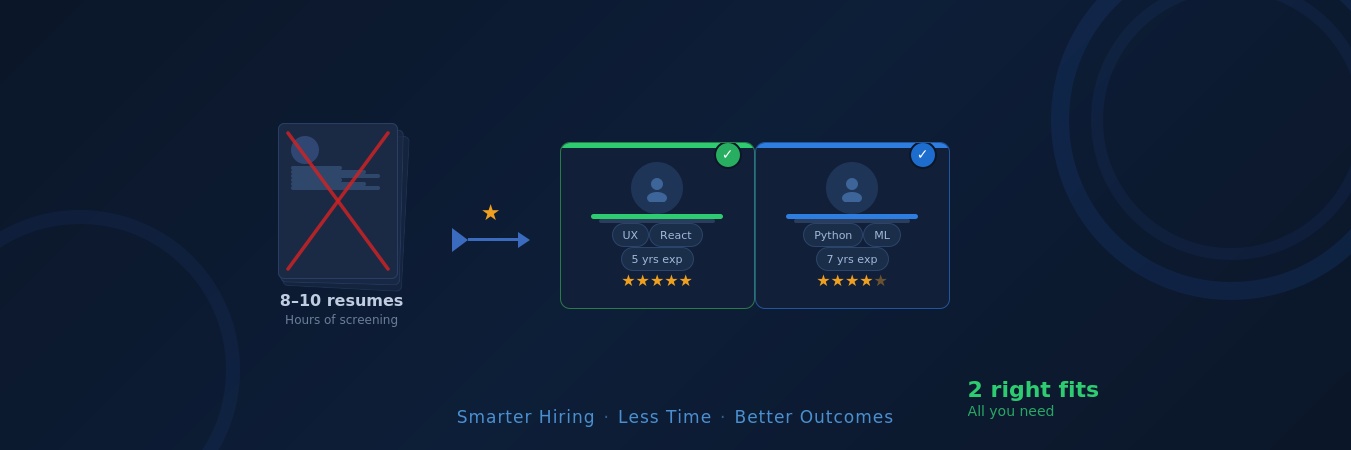
Trying to hire developers fast shouldn’t mean drowning in 8–10 unvetted resumes. Most recruiters send high volumes of profiles not because they found great candidates, but because filtering takes expertise they don’t have. The result? Your engineering team spends 18–22 hours screening, interviewing, and debriefing, only to end up with the same 2 candidates they needed from day one.
This post breaks down exactly what that hidden cost looks like, why the volume model fails technical hiring, and how a 2-profile vetting process delivers interview-ready developers in 72 hours — so your team can stop screening and start selecting.

Think about the last time you tried to hire developers fast. How many resumes landed in your inbox? Eight? Ten? AND of those, how many were actually worth your engineering manager’s time? Two, maybe three — if you were lucky.
Now think about what happened in between. Someone on your team read every profile, shortlisted a few, scheduled calls, sat through technical rounds, and wrote Feedback — only to conclude what a better-screened shortlist would have told you on day one.
That gap — between ten resumes received and two worth hiring — is where your company quietly bleeds time and money.
The Real Reason Recruiters Send 8–10 Profiles
Companies that need to hire developers fast shouldn’t have to choose between speed and quality — but the volume model forces exactly that tradeoff.
It is not because they found ten great candidates. It is because sending more profiles is faster than doing the hard work of filtering them. Running a keyword search on a database and forwarding results takes minutes. Technically evaluating which of those candidates can actually solve your problem takes expertise — and most generalist recruiters simply do not have it.
So the volume model persists. The recruiter appears productive. And the actual screening work — the technical assessment, the culture check, the salary alignment — gets quietly shifted onto your already stretched team.
This is not recruitment. This is cost-shifting dressed up as service.
What Screening 8–10 Resumes Actually Costs Your Business
The cost is rarely calculated, but it is very real. Here is a conservative breakdown of
what a single hiring cycle looks like when profiles arrive unvetted:
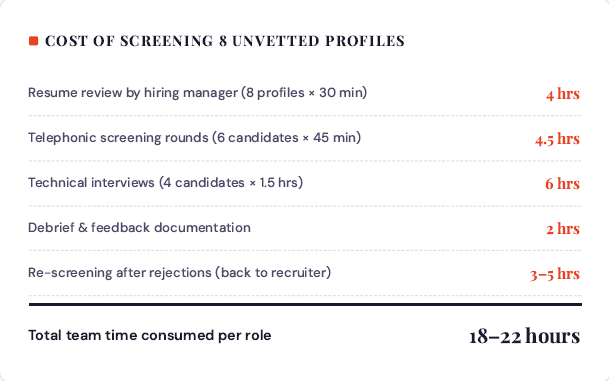
At a senior engineering manager’s billing rate of ₹30–40 LPA, 20 hours of hiring work translates to ₹28,000–₹38,000 in lost productive time — per role, per cycle. For a company hiring four to five engineers a year, that is a silent annual cost of over ₹1.5 lakh in misdirected leadership attention alone.
And that is before accounting for the cost of a mis-hire, which research consistently places at 30–50% of the employee’s first-year salary.
The 2-Profile Model: What It Actually Means
When Tekit Software Solutions says we send two profiles, we do not mean we ran a narrower search. We mean that by the time a candidate’s name reaches your inbox, they have already cleared a multi-stage evaluation designed specifically around your requirements.
Here is what happens before you see a single profile:
- Deep requirement analysis
We go beyond the job description. We understand your tech stack, team structure, growth stage, and the specific problem this hire needs to solve — so we are not just matching keywords, we are matching outcomes. - Role-specific technical assessment
Every candidate completes a custom technical assessment tailored to your actual requirements — reviewed and scored by a senior engineer on our team, not by an automated filter. - Structured Live Interview
We conduct a conversational technical interview to evaluate real problem-solving ability, how candidates communicate under pressure, and how they handle ambiguity — none of which a resume reveals. - Soft-Skill And Culture Alignment
Technical strength without team fit creates friction. We assess communication style, adaptability, and feedback receptiveness — and cross-reference that against what we know about your team’s working style. - Two Profiles, With Full Context
You receive a detailed brief on each candidate — technical assessment results, soft-skill observations, salary expectations, notice period, and our honest recommendation. Everything you need. Nothing you don’t.
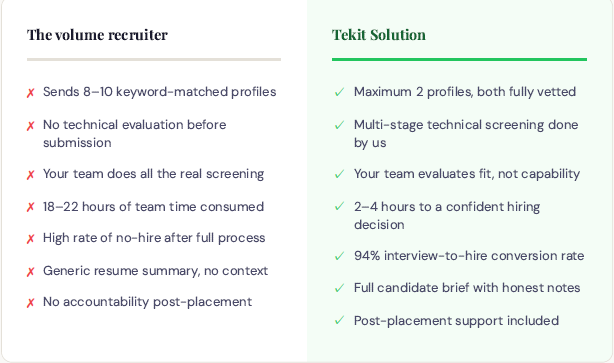
Two Vetted Profiles vs. Ten Unscreened Resumes
What Your Team Should Actually Be Doing In Interviews
When a candidate arrives at your interview table having already passed a rigorous technical assessment, your team’s job changes completely. You are no longer filtering. You are choosing.
That shift — from evaluation to selection — is where great hiring decisions are made. Your engineering managers can focus on team dynamics, long-term vision alignment, and the nuanced judgment calls that only insiders can make. The hard, time-consuming work of technical screening is already behind you.
Who This Model Is Built For
The 2-profile model is not for every company — and we are upfront about that. It is built for organizations where engineering quality directly impacts business outcomes: product startups scaling their core team, mid-stage companies that cannot absorb the cost of a mis-hire, and enterprise tech teams where senior engineers have multiplier effects on everything they touch.
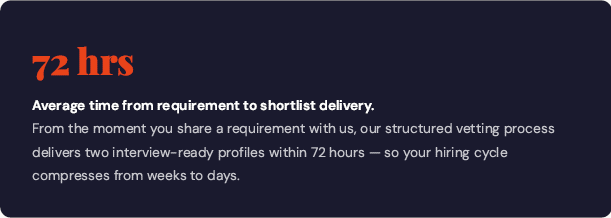
If your priority is volume — 50 CVs by tomorrow — we are not the right fit. But if your priority is built for teams that need to hire developers fast — with the right hire, properly assessed, delivered within 72 hours, that is exactly what we are built to do.
The Bottom Line
Screening ten resumes to find two good candidates is not a process. It is a workaround for a recruiter who did not do their job. Every hour your team spends filtering profiles is an hour not spent building your product, managing your team, or thinking strategically.
The question is not whether you can afford to work with a recruiter who pre-vets candidates. The question is whether you can afford not to.

Leave a Reply