
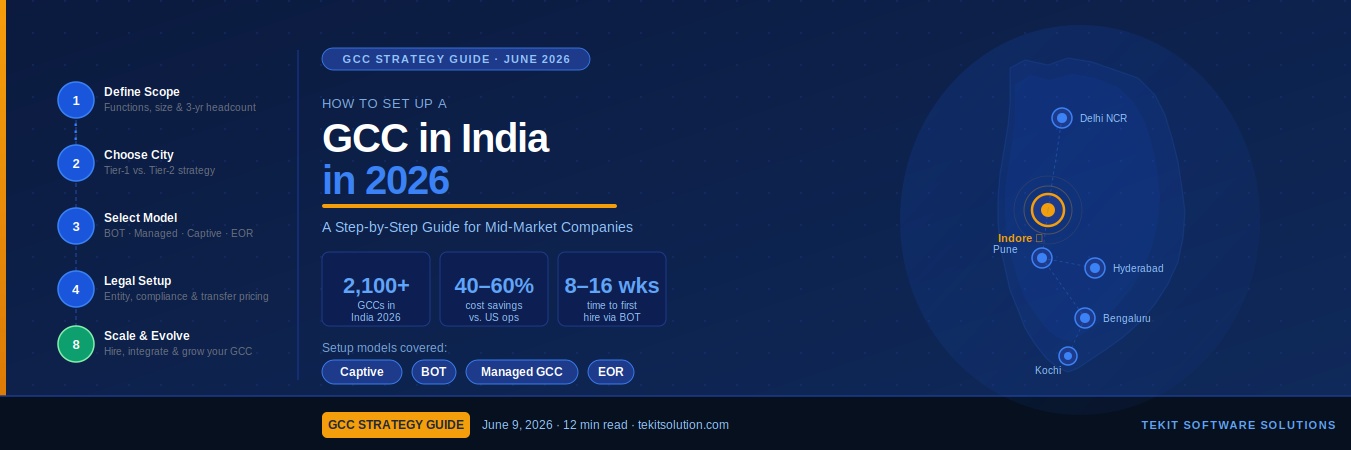
How to Set Up a GCC in India in 2026: A Step-by-Step Guide for Mid-Market Companies
GCCs in India are no longer a large-enterprise privilege. With the GCC market projected to cross USD 952 billion by 2031, mid-market companies — those with 50 to 500 employees — are increasingly setting up their own capability centres and reaping the same cost, talent, and innovation advantages that Fortune 500 companies have enjoyed for decades. This guide walks you through exactly how to do it in 2026, step by step.
What Is a GCC — and Why It’s No Longer Just for Large Enterprises
A Global Capability Center (GCC) is a captive offshore unit set up by a company in another country to deliver technology, engineering, analytics, or business operations at scale. Think of it as your own dedicated engineering team on the ground in India — not a vendor you hire, but an extension of your organisation that you fully own and control.
For years, GCCs were synonymous with IBM, Microsoft, and Goldman Sachs. But that narrative has changed decisively. Today, 480 GCCs — 27% of India’s total — are operated by mid-sized enterprises. The playbooks have matured, the setup models have become more accessible, and Tier-2 cities have opened up entirely new cost brackets. If you’re a CTO or Head of Engineering at a company with 50 to 500 employees, 2026 is the most accessible year in history to set up your own GCC in India.
Why India — and Why 2026 Is the Right Time
India’s GCC dominance is structural, not cyclical. The country hosts over 2,100 GCCs — accounting for approximately 55% of the global GCC market share — and employs more than 2 million professionals across technology, analytics, engineering, and digital transformation. Three factors make 2026 particularly compelling for mid-market entry:
1. Talent that builds products, not just executes tasks
Companies are no longer coming to India for support functions. In 2026, India-based GCCs are running core product engineering, AI research, and global P&L ownership. The talent depth in React, .NET, Python, DevOps, and AI/ML is unmatched globally at India’s price point.
2. Simplified compliance via the Union Budget 2026
The Union Budget 2026 introduced a uniform 15.5% safe harbour margin for transfer pricing, raising the threshold from ₹300 crore to ₹2,000 crore. This now covers over 1,000 existing GCCs and significantly simplifies the most feared aspect of GCC setup: intercompany pricing compliance.
3. Tier-2 city infrastructure has matured
Cities like Indore, Coimbatore, Kochi, and Jaipur now offer Grade A IT parks, reliable connectivity, and strong engineering college pipelines — with 30–45% lower fully-loaded costs than Bengaluru, and meaningfully lower attrition due to reduced employer competition.
Choosing Your GCC Setup Model
Before you set a timeline or budget, you need to choose the right model. This is the foundational decision that shapes everything else — your timeline, IP control, risk exposure, and operational complexity.
| Model | What it is | Time to first hire | Best for |
|---|---|---|---|
| Captive (WOS) | Wholly-owned Indian subsidiary. Full control, full IP protection, full compliance responsibility. | 16–24 weeks | Enterprise Long-term, 50+ engineers |
| Build-Operate-Transfer (BOT) | A local partner builds and runs your GCC for 12–24 months, then transfers full ownership to you. | 8–16 weeks | Mid-market New to India, want speed + path to ownership |
| Managed GCC | You own the GCC but outsource day-to-day HR, payroll, and compliance to a specialist provider. | 6–12 weeks | Mid-market Ownership benefits without operational burden |
| EOR (Employer of Record) | A local provider legally employs talent on your behalf. Zero entity setup. You retain full functional control. | 2–5 days | Pilot Testing India with 5–15 engineers before committing |
Step-by-Step: How to Set Up Your GCC in India in 2026
Here is a practical, sequenced playbook based on how successful mid-market GCCs are being set up in India in 2026.
Define Scope, Size, and Functions
Before anything else, define what your GCC will do. Product engineering? QA automation? AI/ML? Finance ops? The function determines the talent profile, which determines the city. A 30-engineer React/DevOps team belongs in a different city than a 100-engineer BFSI compliance analytics unit. Set a 3-year headcount target — this drives every downstream decision.
✓ TekIT tip: Start with your most bottlenecked function — the one causing the most hiring pain in your home country.Choose Your City and Location Strategy
Tier-1 cities (Bengaluru, Hyderabad, Pune) offer the deepest talent pools but come with higher costs and 20–25% annual attrition. Tier-2 cities (Indore, Coimbatore, Kochi, Jaipur) offer 30–45% lower fully-loaded costs and attrition rates that are meaningfully lower due to limited employer competition and better work-life balance. For teams under 200 engineers, the Tier-2 case is increasingly hard to ignore.
✓ TekIT tip: For full-stack, .NET, React, and DevOps teams — Indore is a strong, undervalued choice with a fast-maturing IT ecosystem.Select Your Setup Model and Local Partner
Based on your timeline, budget, and risk appetite (see the model table above), select BOT, Managed GCC, EOR, or Captive. If choosing BOT or Managed GCC, vet partners carefully — ask for reference clients, a day-one onboarding checklist, and clarity on the transfer mechanics. Misalignment on talent quality and culture from Day 1 is the most common failure point in BOT engagements.
✓ TekIT tip: A good partner should be able to name existing GCC clients in your industry and describe their attrition rate in the first meeting.Legal Entity Setup and Compliance Registration
If going the Captive route, register a Private Limited Company (most common) or LLP. Required filings include company incorporation via MCA, PAN, TAN, GST, ROC, and EPF registrations. Engage a Big 4 or mid-tier Indian accounting firm to set up your transfer pricing policy from Day 1 — most GCCs use a cost-plus model (cost of operations plus 10–15% markup). India’s Digital Personal Data Protection Act 2023 (DPDPA) governs cross-border data transfers and must be addressed in your contracts.
✓ TekIT tip: Budget 8–12 weeks and USD 50,000–150,000 for legal entity setup. Retroactive transfer pricing corrections are expensive — get this right upfront.Office Space and Infrastructure
Grade A IT park leases typically require 3–5 year commitments with 6–12 months of security deposit. In Tier-1 cities, Bengaluru Grade A space averages ₹75–120 per sq ft/month. Tier-2 cities run 40–60% cheaper. Budget for cybersecurity frameworks, cloud infrastructure (AWS/Azure/GCP), collaboration tools, and hardware procurement. Many mid-market GCCs start in managed coworking IT parks to avoid long-term lease commitments during the first 12 months.
✓ TekIT tip: Negotiate for a 12-month break clause in your first lease. Your headcount projections will be wrong — build in flexibility.Talent Acquisition and Onboarding Strategy
Hire a strong India Head before recruiting engineers. This person shapes culture, makes hiring calls, and manages day-to-day operations — the most important hire in your GCC journey. For engineers, partner with a local IT staffing firm with pre-vetted talent to compress time-to-hire. Top-tier GCCs target 10–15% annual attrition; mid-level setups average 15–25%. Retention drivers include career growth paths, competitive pay versus local market (not global), and an actively communicated connection to global product outcomes.
✓ TekIT tip: Publish your salary bands internally from Day 1. Opacity on compensation is the fastest path to attrition in Indian engineering teams.Knowledge Transfer and Integration with Global Teams
The gap between “we have engineers hired” and “those engineers are shipping meaningful work” is where GCCs most often stall. Build a structured 90-day integration programme: Week 1–2 is tooling and codebase orientation; Week 3–4 is paired working with home-country counterparts; Month 2 is shadowed ownership; Month 3 is independent sprint contribution. Avoid the common failure of treating the India team as a feature factory — connect every engineer to a product outcome they can see in production.
✓ TekIT tip: Assign a named “buddy” in your home-country team to every India hire for the first 90 days. Retention improves measurably.Scale, Optimise, and Evolve
Most mid-market GCCs hit their operational stride at Month 12–18. At this point, review your setup model — if you started with EOR or BOT, this is typically the right window to transition to a wholly-owned subsidiary. Expand functions systematically: start with product engineering, add QA automation in Year 2, consider AI/ML or data engineering in Year 3. GCCs that try to do everything at launch consistently underperform those that sequence deliberately.
✓ TekIT tip: Set a GCC maturity review at Month 12 — cost per engineer, attrition rate, sprint velocity, and NPS from home-country stakeholders are the four metrics that matter most.Choosing the Right City: Tier-1 vs. Tier-2 in 2026
Location strategy is not a Year-2 decision. The city you choose determines your talent pool, cost structure, attrition risk, and competitive landscape from Day 1. Here is a practical comparison of the key options for mid-market GCCs in 2026.
GCC Setup Costs: What to Budget in 2026
First-year GCC setup costs in India range from USD 1 million to USD 5 million depending on team size, city, and setup model. Here is a realistic cost breakdown for a mid-market GCC of 30–50 engineers in a Tier-2 city like Indore.
| Cost Item | Tier-1 City (Bengaluru) | Tier-2 City (Indore) |
|---|---|---|
| Legal entity setup & compliance | USD 80,000 – 150,000 | USD 50,000 – 100,000 |
| Office space & fit-out (Year 1) | USD 400,000 – 800,000 | USD 180,000 – 380,000 |
| Engineer salaries (30 FTE, Year 1) | USD 900,000 – 1,500,000 | USD 550,000 – 950,000 |
| Technology infrastructure | USD 100,000 – 300,000 | USD 80,000 – 200,000 |
| Recruitment costs | USD 150,000 – 400,000 | USD 90,000 – 220,000 |
| Total Year 1 Estimate (30 FTE) | USD 1.6M – 3.1M | USD 950K – 1.85M |
5 Common Mistakes Mid-Market Companies Make When Setting Up a GCC
How TekIT Software Solutions Helps You Get There
TekIT Software Solutions is headquartered in Indore — one of India’s fastest-rising Tier-2 GCC cities — with a US presence and a pre-vetted talent pool spanning React, .NET, Angular, Flutter, DevOps, Java, and more. We serve companies looking to:
- Start with staff augmentation before committing to a full GCC — testing the India talent market with pre-screened engineers via C2C or C2H engagement models
- Bridge the gap from a remote team to a full offshore development centre with dedicated engineers, structured onboarding, and transparent pricing
- Explore Indore as a Tier-2 GCC location with lower costs, stronger talent loyalty, and direct access to our existing engineering ecosystem
Whether you’re a CTO exploring your first India hire or an Engineering Director ready to build a 50-person GCC, we’ve been operating in this market since 2018 and can help you move faster with fewer surprises.
Frequently asked questions
What is the difference between a GCC and an offshore development centre (ODC)?
A GCC is a fully-owned captive entity — your company registers a legal entity in India, hires directly, and owns all IP and operations. An ODC is a lighter model where a partner provides managed workspace, HR, and payroll, while you direct the work. ODCs are ideal for pilot teams of 5–50 before committing to the full entity route. Many companies begin with an ODC and transition to a GCC after 12–18 months.
How long does it take to set up a GCC in India?
It depends on the model. An EOR arrangement can have your first hires onboarded in 2–5 days. A BOT or Managed GCC typically delivers first hires in 8–16 weeks. A fully captive entity (WOS) requires 16–24 weeks minimum for legal setup, and often 12–18 months before reaching full operational capability when internal delays and regulatory complexity are factored in.
How much does it cost to set up a GCC in India for a mid-market company?
For a team of 30–50 engineers in a Tier-2 city like Indore, expect first-year all-in costs of USD 950,000 to USD 1.85 million. This covers legal entity setup, office space, first-year salaries, technology infrastructure, and recruitment. Tier-1 cities cost 40–60% more for the same team size. Annual cost per engineer in India ranges from USD 25,000 to USD 80,000 fully loaded — vs. USD 180,000–280,000 in the US.
Is Indore a good city for a GCC in 2026?
Yes — and increasingly so. Indore is one of India’s fastest-rising Tier-2 GCC destinations in 2026. It offers a strong IIT/NIT/engineering college pipeline, high talent loyalty with lower attrition than metro cities, 35–45% lower fully-loaded costs than Bengaluru, Madhya Pradesh state government incentives (capital subsidies, stamp-duty waivers, power-tariff rebates), and a maturing IT park ecosystem. For mid-market companies targeting 30–150 engineers, Indore delivers a compelling cost-quality combination.
What legal structure should I use for a GCC in India?
For most mid-market companies, a Private Limited Company (WOS — Wholly Owned Subsidiary) is the standard choice. It provides the strongest IP protection, allows equity issuance for ESOPs, and is well-understood by Indian regulators. An LLP is simpler to set up but has restrictions on equity compensation — a significant drawback for engineering-focused GCCs. If speed is the priority, start with an EOR provider and transition to a WOS after 12 months.
How do I manage attrition in an India-based GCC?
Top-tier GCCs maintain 10–15% annual attrition; mid-level setups average 15–25%. The proven retention levers are: clear career progression paths, transparent and competitive local-market compensation, strong connection to global product outcomes (engineers who can see their code in production stay longer), active manager relationships, and location choice — Tier-2 cities have structurally lower attrition than metros due to limited employer competition and better work-life balance.
Ready to Build Your GCC in India?
TekIT Software Solutions has been operating in Indore’s IT ecosystem since 2018. Whether you want to start with 2 augmented engineers or plan a 50-person dedicated GCC, we can help you move faster with fewer surprises.
Book a Free GCC Consultation Explore Staffing Models
Leave a Reply